

PM Case Study: Oneshot. AI | Most AI Products Fail Because They Solve the Wrong Problem | Part 1 : Cohort Analysis

Updated: Apr 9
Inside a Product Manager’s 12-Month Diagnosis of an AI Sales Tool
This blog is about the AI product management case of how Our GP and Group PM Gokul Rangarajan worked with OneShot AI, a B2B sales Chrome plugin, repositioned and reinvented its product's core from a tool to a platform using user research, customer research, secondary research, and strategic decisions. This blog breaks down Gokul's 9–12 months of working experience closely with Founder Oneshot.ai which helped them to raise 3M+ from 42CAP and eventually get to 2M ARR.
This is 3 part blog case study is based
how a promising AI product with users and revenue was not delivering real workflow value.
how user research and product analysis revealed the wrong problem being solved
how we rethought the product from a personalization tool → autonomous outreach platform When we started working with Oneshot.ai in November 2021 alongside Venki Pola and Gautham Rishi, the product already looked like what most people would call "working". The product had AI capabilities layered into the core experience. It had early traction, roughly fifty active users, and had already generated close to $20,000 in revenue and one paying enterprise customer custom-made to their workflow. From the outside, it checked the boxes most early-stage AI products aspire to reach: functional technology, initial adoption, and some signs of monetisation. But within the first few weeks of engaging with the product, team and leadership, something didn’t sit right.
Nov 2021
At that time, OneShot.ai was positioned as an AI-powered Chrome extension that helped sales teams generate personalised LinkedIn messages and cold emails.

The Product promise was straightforward: use AI to create highly tailored outreach at scale, something SDRs have historically struggled to do consistently. On paper, it made perfect sense. Personalisation has long been considered a key driver of outbound success. Response rates improve when messages feel relevant. Sales leaders talk about it constantly. The market, sales and SDR community reinforce it.
So what started as a simple engagement became a full product diagnosis:
Why users were not sticking
Why AI features were not translating to value
And what the product actually needed to become
So instead of assuming the premise was correct, I went deeper into three parallel tracks: Product usage analysis , User interviews, s, and market research.
Dec 2021-Product usage analysis
Before changing the product direction, we started with something more basic.
We looked at onboarding and Time to Value analysis . Because if users don’t understand value early, nothing else matters, including how users moved from:
installing the Chrome extension → actually using it inside LinkedIn or Eamil
On the surface, onboarding looked complete.
Users could:
sign up
connect accounts
land on LinkedIn
start using personalisation.
But when we tracked behaviour closely, the drop-offs were significant.
What We Actually Measured
We broke the onboarding into a step-by-step behavioural funnel.
Not vanity metrics like signups but product usage signals.
We started tracking:
How many users installed the extension
How many reached LinkedIn profile pages
How many triggered personalization
How many actually used the generated message
How many sent outreach
This was important because the product promise was:
“AI will help you personalize outreach at scale.”
So the real question became:
Are users actually reaching the moment where they experience this value? The user interviews
The “Aha Moment” We Expected
The expected “aha moment” in the product was simple:
A user opens a LinkedIn profile → OneShot analyses the profile →Generates a personalized intro →User sends it.
That moment should create a feeling of:
“This saves me time. I want to use this every day.”
But that wasn’t happening consistently. How we found ou this ? Looking at real usage patterns, a different picture emerged. A large majority of users were able to successfully reach LinkedIn after installing the extension, and nearly 65–70% triggered the AI at least once, with around 55% generating a personalised message. On the surface, this suggested strong feature adoption. But when we tracked what happened next, the funnel broke sharply. Less than 20–25% of users actually copied or used the generated message, and fewer than 10–12% went on to send outreach.

Even more concerning, onboarding completion itself was inconsistent—while users signed in, nearly 30–40% never fully completed onboarding flows, and a meaningful segment dropped off before experiencing the first real value moment. This meant users were reaching the feature but not crossing the threshold into meaningful usage.
Stage | Event Trigger | User Tier | Metric | How We Measured It | What We Learned |
Install → LinkedIn Entry | Extension activated + LinkedIn page load | New Users | ~70–75% reached LinkedIn | Chrome extension install event + domain tracking | Strong intent; users were curious and explored immediately |
LinkedIn → AI Trigger | tracking and edit | Activated Users | ~65–70% triggered AI | UI click events inside LinkedIn overlay | Feature discovery was high; users understood where value might be |
AI Trigger → Message Generated | AI generation success event | Engaged Users | ~50–55% generated message | Backend generation logs (API success events) | AI capability was working and being explored |
Message Generated → Message Used | Copy/Edit interaction | Evaluating Users | ~20–25% used output | Clipboard tracking + edit interactions | First major drop low trust in output or unclear usability |
Message Used → Message Sent | “Copy to LinkedIn” / send action | High-Intent Users | ~10–12% sent outreach | Proxy via copy + interview validation | Critical break product not driving real-world action |
Onboarding Completion | Completed setup (company + context) | Signed-up Users | ~60–70% completed onboarding | Funnel tracking across onboarding steps | Users signed in but didn’t fully activate |
First Value Moment | Generated+ reviewed and stayed in flow | Activated Users | ~30–35% reached aha moment | Multi-event condition (generate + dwell time + interaction) | Weak value realization; moment not strong enough |
Repeat Usage | Returned to use feature again | Retained Users | 8–9% repeat usage | Cohort retention (Day 1 / Day 7) | Product not part of daily workflow |
Trial → Active | Integrated into outbound workflow | Power Users | Low (qualitative) | Combined usage and interview validation | Product explored, not operationalized |
What became clear was that engagement was shallow. Many users tried the one-line personalisation once, but only ~8–9% returned to use it consistently, and trial-to-active conversion remained low.

Time-to-value was also longer than expected users weren’t immediately confident in using the output within their workflow, which reduced repeat behaviour. The product was being explored but not adopted. Users were onboarding but not internalising value. And even when they experienced the core feature, it wasn’t strong enough to change behaviour. The system was generating outputs but not driving action—and in a workflow product, that gap between generation and execution is where products fail.

This made us to dive deeper into other analsis to find pattern what we could get form users. Cohort Segmentation
By dividing users into groups with shared characteristics or experiences, we analysed this to understand whether users naturally progressed across value stages. We found out 50–60% of SDRs were generated once and dropped, while less than 10% moved to repeated usage.

The signal was clear: users were not transitioning from trial to usage, indicating broken value progression, not a top-of-funnel issue.
Value wasn’t progressive → users saw one-time benefit, not increasing returns
UX didn’t guide users from generate → act → repeat
Workflow mismatch → no natural next step after first use
Free → Paid Conversion Breakdown
We analysed this to diagnose conversion failure.

<5% of SDRs reached a stage where they could evaluate ROI meaningfully (multiple sends across prospects).
Users never accumulated enough usage depth to justify a buying decision—conversion was blocked before pricing even mattered.
Users didn’t reach outcome → no ROI signal formed
Trust insufficient → not enough successful sends to justify payment
Value not aggregated → benefit felt isolated, not compounding
Time-to-Value vs Time-to-Trust
Latency between text generation and action was analyzed <5 minutes to generate output, but >80% of SDRs never acted on it within the same session. Fast value exposure without immediate action indicates lack of trust, not lack of utility.

Generation fast (<1 min), but decision to send requires confidence in reply rate
SDRs mentally simulate: “Will this get ignored?” → high uncertainty → no send
No past success memory → each message judged from scratch
False Aha Moment Detection
We analyzed this gap to validate activation quality, In PLG SaaS, activation is typically measured by a user reaching a meaningful first action like creating a project, sending a campaign, or publishing something live. In outbound tools, this usually translates to a user completing and executing an outreach step, not just preparing for it. Across multiple PLG case studies (e.g., email tools, CRM workflows), the activation event is tied to a completed action inside the user’s workflow, not a preview or intermediate step.
In tools like Slack, value is realized when a team sends messages and gets responses—not when they just set up channels. In Notion, activation happens when users create and organize content they return to not when they browse templates. Similarly, in outbound tools like Apollo.io or Outreach.io, value is tied to sending sequences and engaging prospects, not drafting messages.

In the OneShot case, the product defined activation at the point of generating a personalized message. That aligns with feature usage, but not with how SDRs actually operate. For an SDR, generating a message is only a preparatory step the real job is reaching out and driving responses. Observationally, users were engaging with the generation flow, reading outputs, and sometimes refining them, but stopping short of integrating that output into their actual outreach workflow.
50% of SDRs generated personalization, but only ~10–12% acted on it. The insight: generation created a perceived aha, but real activation required action—our “aha definition” was incorrect.
SDRs react to output: “Looks good” → but next thought: “Will it work?” " do i really need it ?
Without outcome signal (reply/meeting), “aha” collapses within seconds
Generation ≠ quota impact → no behavioral shift
This creates what can be called a “false aha moment.” The product surfaces something that looks valuable in isolation, but it doesn’t map to the user’s definition of success. In PLG terms, the system is capturing intent signals without completion signals. The distinction matters because real activation requires the user to cross a behavioral threshold—moving from seeing value to relying on it. Without that shift, what appears as activation in product metrics is actually just structured exploration.
Activation Depth Analysis

Depth of interaction post-generation matters but ~30% of SDRs interacted beyond viewing, but less than half of them progressed to sending. Activation needs to include decision-making, not just interaction—users engaged but did not commit.
SDRs stopped at generation because editing cost ≈ writing from scratch
No reduction in thinking effort → cognitive load unchanged
If tool doesn’t save ≥30–40% effort, SDRs abandon
Retention Cohort (D1–D7)

~30–35% first-session usage dropped to ~10–15% within a few days and <10% by week one. We analyzed retention to check habit formation. Lack of repeat usage indicates the product is not tied to a recurring workflow.
Behavior Cohort Progression
~50% generated, ~20–25% used output, ~10–12% sent messages. We analyzed stepwise drop-offs across behavior.

the biggest break is between evaluation → action, not discovery → usage.
SDR flow: open profile → decide fast → send or skip
Tool inserted extra step → slowed decision loop
Anything breaking high-velocity loop gets dropped
Onboarding Drop-Off Analysis
We analyzed onboarding to check activation readiness.
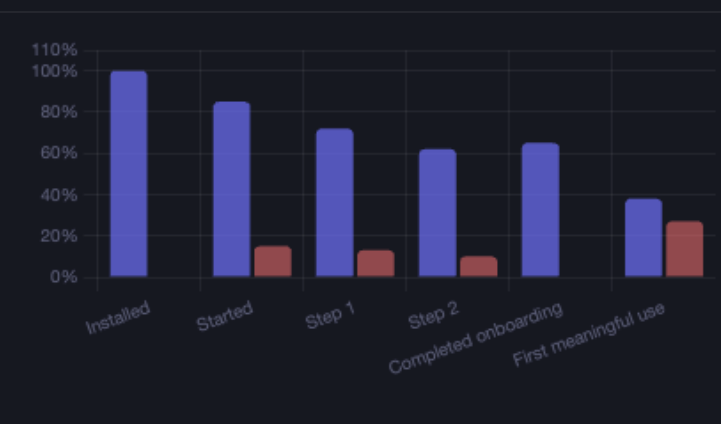
~30–40% of SDRs dropped before completing onboarding, and an additional drop occurred before first meaningful use.
The signal: completing onboarding did not guarantee value understanding—onboarding was not aligned to outcome.
Value Depth Layer Analysis
We analyzed depth of value engagement what we found is overall 50% reached shallow value (generation), ~20% mid-level (usage), ~10% deep value (sending). value was accessible but not compelling enough to drive deeper progression.
SDRs care only about message → reply → meeting
Generation alone doesn’t move pipeline → seen as low-value layer
Deeper value (reply outcomes) not visible → no progression
Free User Non-Conversion Analysis
80% of SDRs remained in exploratory usage without repeated action. We analyzed why free users didn’t convert. The takeaway: users didn’t see consistent outcomes, so they didn’t build conviction to pay.
Trust Formation Analysis

50% saw outputs, but only ~20–25% used them and ~10–12% acted. We analyzed the drop between output and usage. Trust degraded across stages seeing output ≠ believing it is good enough to use.
Exploration vs Habit Analysis

~60% of SDRs used the product once, while <10% formed repeat behavior. We analyzed session frequency over time.
Workflow Integration Analysis

<10% of SDRs used the product consistently within their outreach process. We analyzed integration into daily work. The product was adjacent to the workflow, not embedded within it.
Output vs Outcome Analysis

50% generated outputs, but only ~10–12% converted to outreach actions. We analyzed output-to-outcome conversion. The insight: output quality alone does not create value unless it leads to outcomes.
ICP Identification via Behavior
<10% of users demonstrated repeated usage patterns aligned with structured outbound workflows. We analyzed behavior of retained users. The product fit users with defined workflows, not ad-hoc usage patterns.

SDRs with structured outbound (lists, sequences) engaged more
Ad-hoc prospectors didn’t need tool consistently
Product required repeatable workflow to show value
Drop from ~50% generation to ~10–12% sending. We analyzed this gap specifically. The takeaway: the hardest problem is not generating content—it is enabling the decision to act on it.
Product-Market Fit Misalignment

50% of users didn’t need deep workflow automation, while <10% needed more than the product offered. We analyzed mismatch across cohorts. The insight: the product sat between shallow and deep use cases, failing both segments.
Final Takeaways (What We Actually Learned)
The core question wasn’t whether users found value—it was what kind of value they expected vs what we delivered. SDRs did find the one-line personalization interesting and occasionally useful, but not critical enough to change behavior. The value was incremental, not transformational. It helped improve a message, but it didn’t meaningfully improve what SDRs ultimately care about—getting replies and booking meetings. Because of that, the benefit didn’t compound over time, and without compounding value, there was no reason to build a habit or pay for it.
The second layer was a workflow issue. SDRs don’t operate in isolated steps—they work inside fast loops: find → write → send → move on. OneShot inserted itself into that loop but didn’t reduce enough friction across the full workflow. If the product had lived directly inside their existing flow (e.g., deeper LinkedIn automation or sequencing), it might have reduced effort meaningfully. Instead, it behaved like an assistive layer that required extra thinking at the decision moment, which is exactly where SDRs optimize for speed.
The third realization was around the nature of personalization itself. One-line personalization is helpful, but not a strong enough wedge. SDRs are comfortable writing one-liners themselves, and they don’t assign high monetary value to that task. More importantly, personalization alone doesn’t guarantee outcomes. The real value sits in who to reach out to, when to reach out, and why now. Without that context (signals, targeting, timing), improving the message itself felt insufficient. In short, we optimized the message, but SDRs optimize for pipeline.
Open Questions from the Analysis
Are SDRs actually not finding value, or is the value too small to change behavior?Users are engaging with message generation, but does that mean they believe it improves outcomes—or just that it’s interesting to try?
Is this a compounding value problem?If the benefit from one-line personalization is incremental, does it fail to build enough momentum across multiple sends to justify repeated usage?
Is this a workflow placement issue?If the product sits outside the core outbound loop, are SDRs dropping off simply because it interrupts their speed, not because it lacks utility?
Is one-line personalization itself a weak value wedge?If SDRs can already write one-liners quickly, is the product solving something they don’t perceive as worth outsourcing?
Is the problem actually upstream?Are SDRs struggling less with “what to write” and more with “who to target and why now,” making personalization feel secondary?
Does channel context affect behavior?If users are more cautious on LinkedIn, does the same output feel less usable compared to email workflows?
Hypothesis | % Range | Next action item |
Users find value but don’t act on it | ~55–65% → ~25–30% | User interview |
Value doesn’t compound | ~8–12% | User interview |
Workflow friction causes drop-off | ~55–65% → ~12–16% | Onboarding A/B experiment |
One-line personalization is low-value | ~60% gen vs ~10–15% send | User interview |
Problem is upstream | ~20–30% regenerate | Onboarding A/B experiment |
Channel affects trust | ~2–4% difference | Growth experiment |
Did changing communication alone improve behavior or does reframing value from personalization to outcomes actually move SDR actions?
Do SDRs behave differently when context is added—like signals, timing, and “why now” on top of personalization?
And is personalization only valuable when it’s embedded directly into the outbound workflow, rather than sitting as a separate step?
In the next post, we break down what happened when we tested these assumptions in the product.


Comments